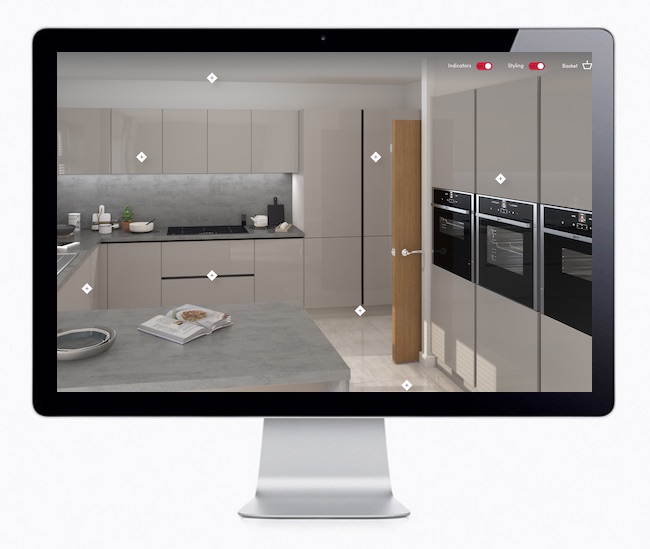
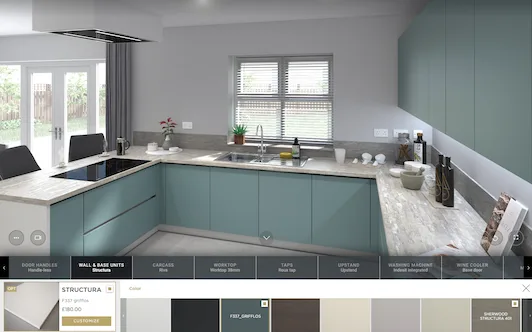
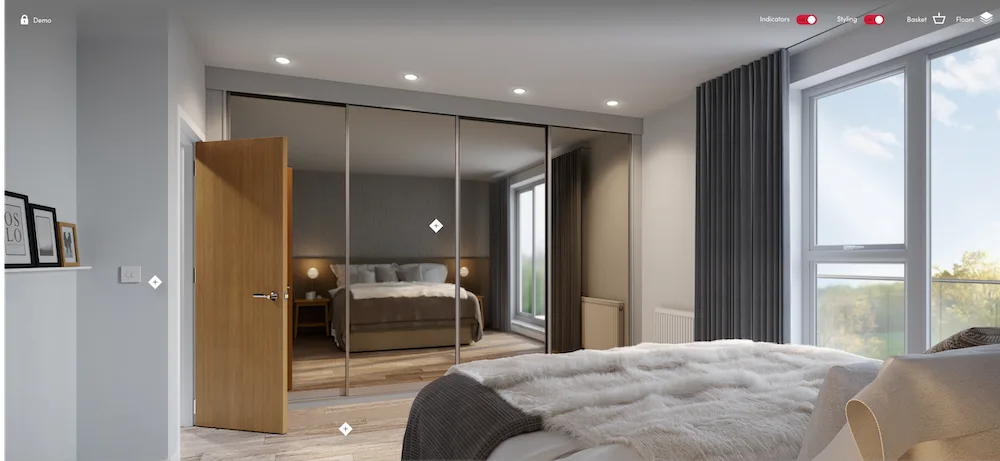
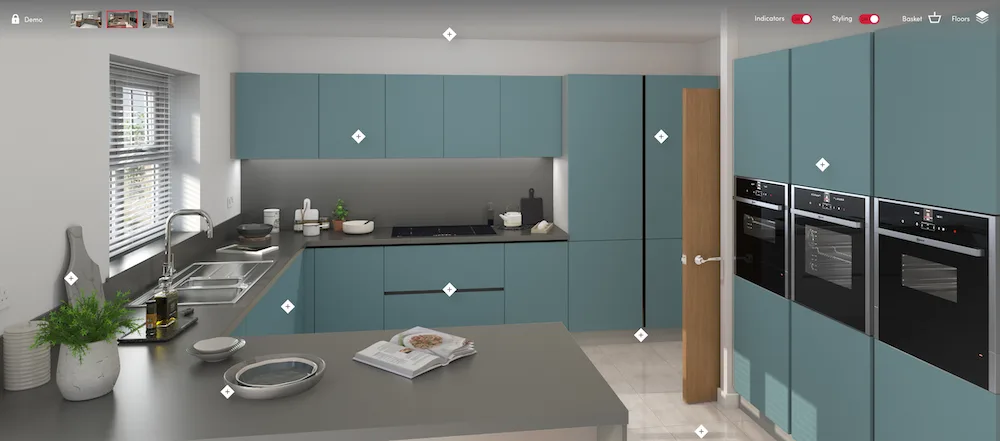
The house building industry sells shells well and fills them badly: buyers choose handles, tiles and kitchen finishes from small, sometimes minimal lists, then replace the fixtures soon after moving in. A Doncaster house builder asked me to work out how and what could be done about it. I designed the configurator requirements, ran a global supplier search down to a shortlist of 5 and two finalists, managed a proof of concept, then the full programme: 20 house types, every room configurable, 35,000+ options linked to business logic and ordering. Cross sales rose 55%.
What was the problem?
The house building industry has historically been adept at "selling shells" but curiously, not so clever at filling them. New house buyers move into their homes having selected handles, tiles, kitchen finishes and the rest from small, sometimes minimal lists. Instances are high of new owners replacing all the fixtures, including doors, soon after moving in.
So satisfaction with the final product was dampened, and a profit opportunity missed.
A Doncaster-based house builder had developed a brand based on high quality design, practical affordability and good build quality. Now they needed ways to enhance the personalisation experience, and they asked me to research how and what could be done.
What did I do?
The embryonic idea started with cost and benefit analysis, and setting parameters and objectives.
Stage 1: requirements and supplier choice
Detail of the full configurator requirements and ordering process was developed, with the outcome being a request for proposal document. Identifying suitable suppliers and auditing their skills produced the shortlist.
Stage 2: supplier choice and proof of concept
Suppliers' responses to the RFP were analysed on a range of criteria, with an appointment made following contract review. The proof of concept project then launched. One house type was developed in 3D, along with a limited set of product options, to prove the process works. Testing the POC with a live audience generated practical and positive feedback.
Stage 3: full development
The project moved on to developing a suite of more house types and, more importantly, the addition of a huge range of customisable options, 35,000+ of them. Other extensions included developing business logic and the full ordering process.
The client were in the throes of developing new offices and created a configurator suite, featuring a fully interactive touchscreen wall for using the configurator, alongside samples and ideas for surfaces and finishes.
My own work across that ran to:
Designing the configurator requirements
Researching potential global suppliers, shortlisted to 5
Developing the request for proposal and submitting it to suppliers
Reviewing proposals and interviewing the 2 finalists, 1 in Belfast, 1 in Kiev, Ukraine
Setting requirements for a proof of concept configurator
Managing the POC project, advising the client and working with suppliers
Full testing of the POC configurator
Post-POC, developing requirements for the full programme of work: 20 house types, all rooms configurable, linked into a database for products and business logic rules
Managing the programme for the configurator and the database controller that supplies it with business logic for customer orders
The technical uncertainties surmounted
House configuration had never been tackled previously in the market
Whether a whole house could be configured with photo quality imagery in real time in a web browser, with no time lag
Enabling an order to be placed from the configurator by the user
A configurator that operates in a web browser without the need for plugins
Configurator usability across desktop, laptop and tablets, not mobile due to screen size limitations
Ensuring no impact on website page speeds
What was the result?
Cross sales rose 55%. The tool behind that carried 35,000+ customisable options across 20 house types, with an ordering suite for the client's customers.
Clients increase in optional upgrades
Auditable reports of customer choices in the configurator
Single customer invoice for all upgrades
Cross sales up 55%
What does this show?
A market nobody has built for yet is a requirements problem before it is a technology problem. The proof of concept existed to answer one question, whether a whole house could be configured photo-realistically in a browser with no lag, and answering it cheaply on one house type is what made the full 20 defensible. The uncertainties were listed before the supplier was chosen, not discovered afterwards.
Because one question had to be answered before the money went in: whether a whole house could be configured with photo quality imagery in real time in a browser, with no lag. One house type in 3D with a limited set of options answered it, and testing with a live audience gave practical feedback before the full programme started.
How do you choose a supplier for something nobody has built?
On requirements rather than on a demo. The full configurator requirements and ordering process were written first, then turned into an RFP, then suitable suppliers were identified and their skills audited to make a shortlist of 5. Two finalists were interviewed, one in Belfast and one in Kiev.
Why is it not available on mobile?
Screen size. The configurator was built to be usable across desktop, laptop and tablet, and mobile was excluded deliberately rather than left to degrade badly. Page speed on the main website was a stated constraint too.
Not sure where to start?
Most clients begin with a conversation. No pitch, no hard sell.
Just a straightforward discussion about where you are and whether I can help.