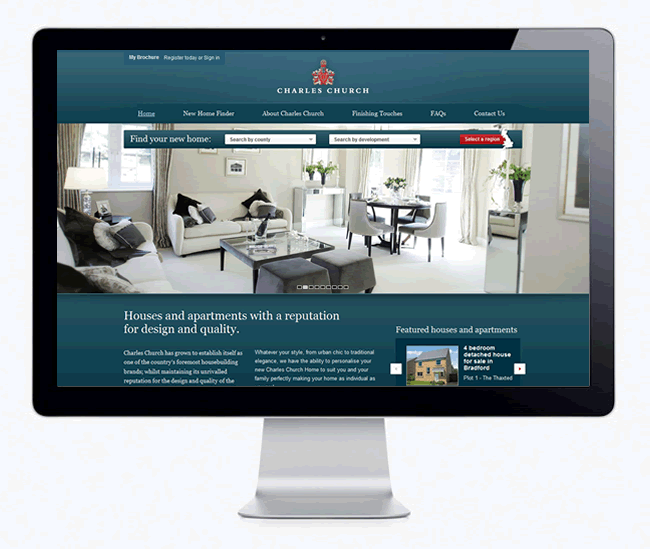
Charles Church wanted to come out of the recession at the front of the market, able to react quickly to customer demands rather than shouting about itself the way most property sites do. I ran the research first: competitor analysis, then how people actually search for new homes in a location, then user needs and information architecture. The result was a customer-centric site with a COINS-integrated development plan showing plot availability, price and location in real time, and clear book-a-viewing calls to action that produced a major increase in bookings and reservations.
What was the problem?
Charles Church wanted to come out of the recession at the front of the market: able to react quickly to customer demands and exceed their expectations, delivering the content the user was expecting and wanted.
So many property sites simply shout who they are and ignore the customers' needs. The brief was the opposite of that, a site where the user felt they were driving the journey and had their questions answered.
What did I do?
The first steps were to analyse the current competitor offerings, and to research how users search for new homes and houses in a location.
From there a tried and tested process: user needs, user acquisition, information architecture. Those steps establish the best way to design and build the website.
User acquisition. Analyse the current online presence: search engine position, content quality, keyword themes and silos, competitor analysis.
User needs. Research and analysis to establish expectations and therefore goals for the site. Internal analysis of process to ensure needs could be met both digitally and through conventional processes: meetings, viewings, paperwork.
Information architecture. Full site structure, and a prototype mock up.
What was the result?
A customer centric website that is easy to use and focuses on the user and their needs, giving full information not just on the developments and plots but also local information.
A fully integrated site plan, connected to COINS, showing plot availability, price and location in real time.
Users can prepare their own downloadable brochure of favourite developments, plots and locations.
Clear calls to action, book a viewing, from all pages, which had a major increase in bookings and reservations as a direct result.
What does this show?
Thorough research of the competition establishes the benchmarks and the opportunities before anyone designs anything. Consumer research, and respecting the results rather than overriding them, produces fresh insight and sets realistic expectations. And planning the architecture properly is what keeps the agreed goals deliverable and affordable.
Following a process meant the results reflected the needs of the market and the user, not the opinion of one or two people in the company, who are not necessarily web build experts or buyers of their own properties.
Why research competitors before designing anything?
Because it establishes the benchmarks and the opportunities, and it does so before anyone has an opinion to defend. Knowing how users search for new homes in a location is what decides the structure; starting with design means deciding it on taste.
What does integrating the site plan with COINS actually get you?
Plot availability, price and location that are true at the moment someone looks. A plan maintained by hand is wrong within a week, and a buyer who enquires about a plot that has sold does not come back.
Not sure where to start?
Most clients begin with a conversation. No pitch, no hard sell.
Just a straightforward discussion about where you are and whether I can help.